Quiet Pines Counseling — Therapy & Counseling Practice Website (8 Pages)
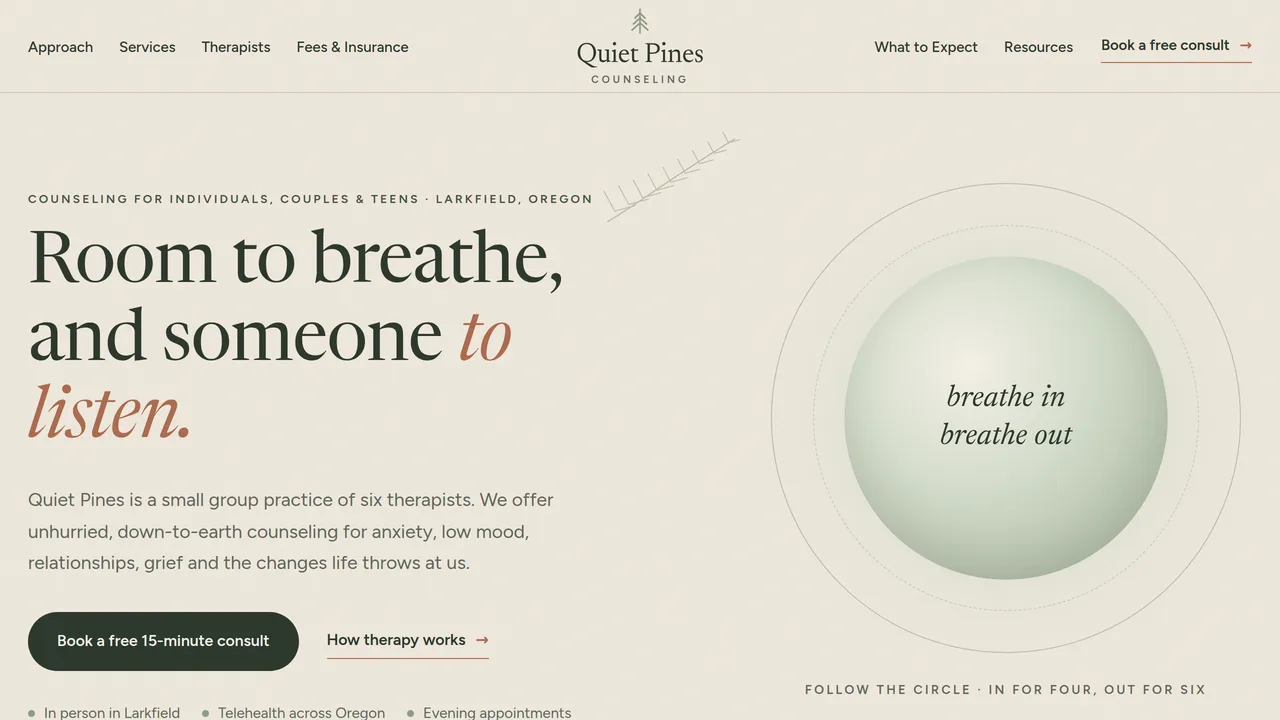
An 8-page website for a counseling or therapy group practice — a calm editorial design with a breathing-circle hero, an "Is this for me?" concern selector, therapist cards, a sample fee table with sliding scale and Good Faith Estimate notice, crisis resources, a grounding exercise and a free-consult request form, with MedicalClinic SEO markup.
Preview
What you can customize
Each section below becomes a guided form field in your library after purchase — no prompting experience required.
- 1
Home
Editorial hero beside a CSS breathing circle, staggered photo triptych, welcome note with pull quote, 'Is this for me?' concern tabs, ways we work rows, how-therapy-works timeline, pine-line quote, three therapist cards, 5-4-3-2-1 grounding card, count-up facts, consult CTA.
2 editable fields
- 2
Our Approach
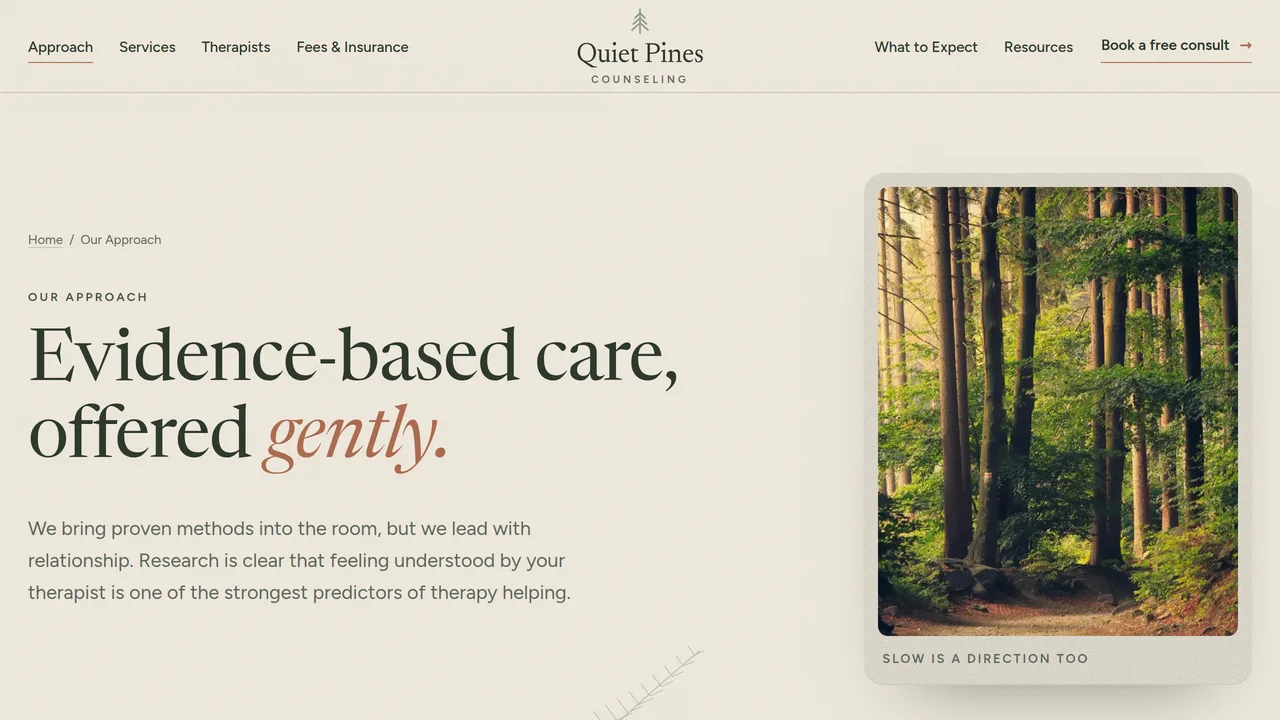
Three beliefs in hairline columns, plain-English guide to therapy methods (CBT, ACT, EMDR, EFT, Gottman, IFS), what the space feels like, pull quote with pine drawing, inclusive-care statement.
2 editable fields
- 3
Services
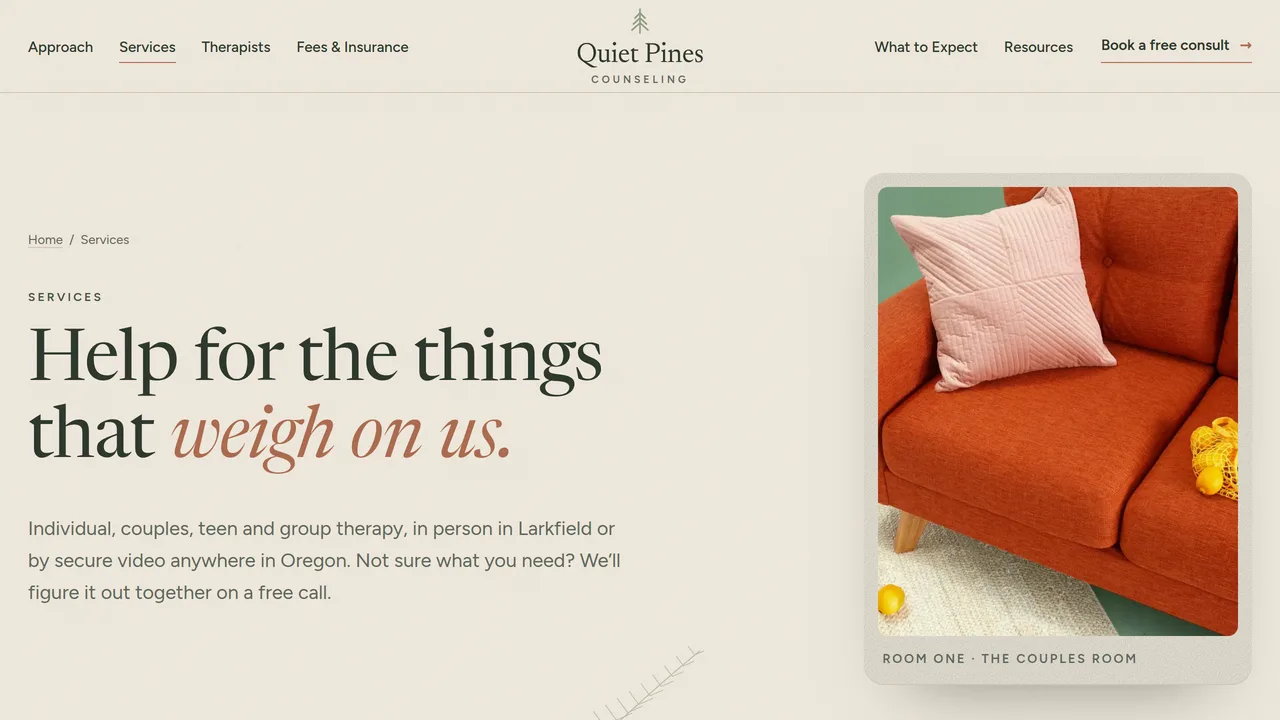
Nine service cards (individual, couples, teens, anxiety, depression, grief, transitions, trauma-informed, telehealth), weekly anxiety skills group feature, session lengths, honest right-fit note.
2 editable fields
- 4
Our Therapists
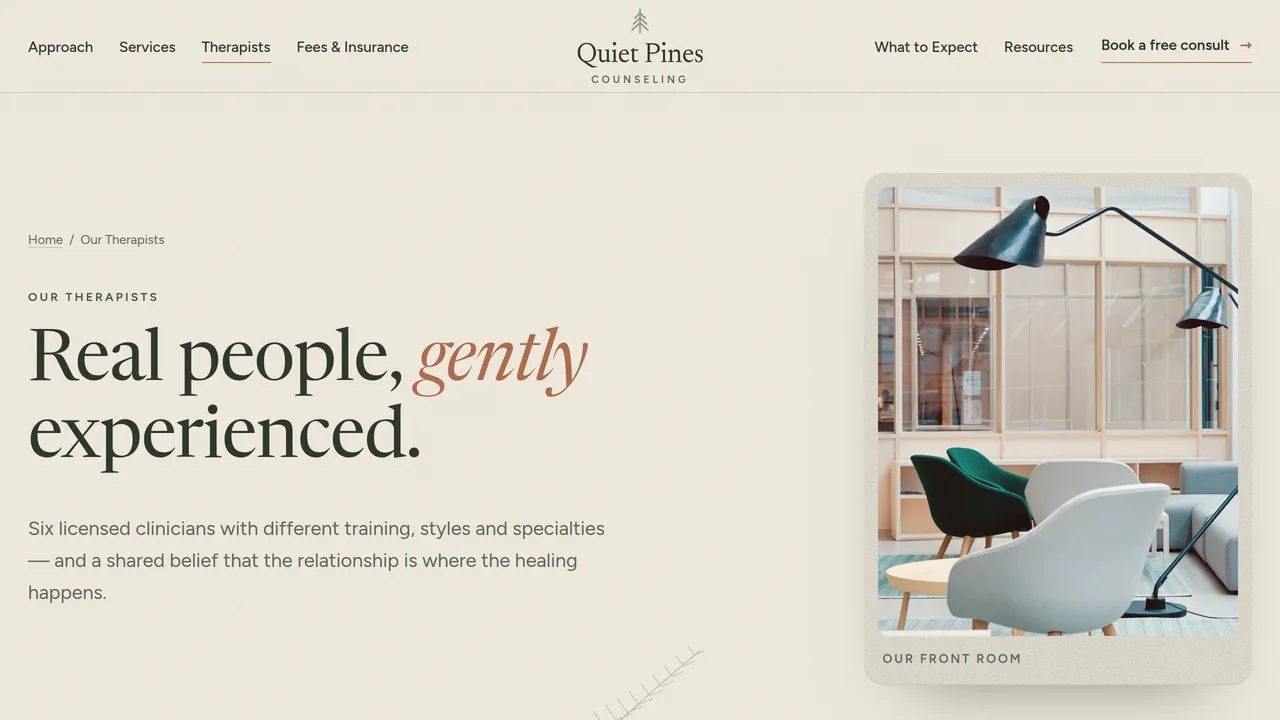
Six monogram therapist cards with license, pronouns, bio and specialty chips; finding the right fit; what LPC, LCSW, LMFT and PsyD mean; team pull quote.
2 editable fields
- 5
Fees & Insurance
Sample fee table with superbill codes, in-network plans, sliding-scale spots meter, out-of-network superbill timeline, Good Faith Estimate notice (No Surprises Act), payment FAQ.
2 editable fields
- 6
What to Expect
First-session timeline, telehealth checklist, confidentiality and its limits cards, eight-question FAQ (FAQPage markup).
2 editable fields
- 7
Resources
Crisis box (988 Suicide & Crisis Lifeline, 911, Crisis Text Line, Trevor Project), 5-4-3-2-1 grounding card, six worksheets, eight recommended books, pine drawing.
2 editable fields
- 8
Request a Consultation
Free 15-minute consult request form with not-for-emergencies notice, crisis box, next steps, visiting details and hours.
2 editable fields
Launching it is simple: download the files, publish it live to your own Vercel account, or push it to your own GitHub — see how to launch your AI Tapz website.
Usage instructions
8 pages, each a complete, self-contained HTML page — a calm, quiet editorial design for a counseling and therapy practice: an asymmetric 12-column grid with lots of whitespace and hairline rules, Newsreader headlines (italic accents and large pull quotes) over Figtree, a warm oat-paper, sage, deep moss and muted clay palette, soft-cornered tall portrait photos (some mounted on a paper-texture border), subtle paper grain and pine-needle line art. 1. Home (index.html) — headline beside a breathing circle, photo triptych, welcome note and pull quote, "Is this for me?" concern selector, ways we work, how-therapy-works timeline, pine-line quote, three therapist cards, 5-4-3-2-1 grounding card, count-up facts, consult CTA. 2. Our Approach (approach.html) — three beliefs, a plain-English guide to therapy methods, what the space feels like, pull quote, inclusive-care statement. 3. Services (services.html) — nine service cards, the weekly Steadier Ground group, session lengths, an honest "when we might not be the right fit" note. 4. Our Therapists (therapists.html) — six monogram therapist cards with specialty chips, finding the right fit, what LPC / LCSW / LMFT / PsyD mean. 5. Fees & Insurance (fees.html) — sample fee table, in-network plans, sliding-scale spots, out-of-network superbill steps, the Good Faith Estimate notice, payment FAQ. 6. What to Expect (what-to-expect.html) — first-session timeline, telehealth, confidentiality and its limits, FAQ (FAQPage markup). 7. Resources (resources.html) — crisis box, grounding card, worksheets, recommended reading. 8. Request a Consultation (contact.html) — free 15-minute consult request form, crisis box, next steps, visiting details. ANIMATION. The home hero's breathing circle slowly grows and shrinks on a ten-second cycle (four counts in, six out) with "breathe in / breathe out" captions — it is pure CSS, so it also runs in the editor. Sections fade in slowly as you scroll, photos drift in gentle parallax, the hand-drawn pine line draws itself, the timelines' hairline fills as you scroll past, the facts count up (they read the number you type) and the sliding-scale meter fills. Everything is visible without JavaScript, and visitors who ask for reduced motion see a still page (the breathing circle stops, and both captions show). CONCERN SELECTOR. The "Is this for me?" tabs on the home page each pair a tab link with the panel in the same position — keep the number of tabs and panels equal when you add or remove one. Edit the client-voice quotes, help text and chips to match your clinicians. GROUNDING CARD. On the home and Resources pages, visitors can tap each line of the 5-4-3-2-1 card as they notice it; it simply fades that line. No data is stored. FONTS. Newsreader (regular and italic) and Figtree load from Google Fonts via @font-face in each page's style block, with Georgia and system sans-serif fallbacks. SEO. Each page opens with a labeled block (title, meta description, canonical link, Open Graph tags and JSON-LD — MedicalClinic on the home page with the services offered, plus AboutPage, CollectionPage, FAQPage and ContactPage). Copy it into your real <head> when you deploy, and update the domain, address, hours and services. FORMS. The consultation request form posts nowhere and ships no backend. Connect it to a HIPAA-compliant form service or your practice-management / EHR system before publishing — a general-purpose form tool or ordinary email is usually not appropriate for health information. The form already tells visitors it is not for emergencies and not to include detailed health information; keep those notes. EDITING. Change colors and fonts site-wide in the editor's Theme panel; edit the header or footer once and use "Apply to all pages"; sections can be moved, duplicated, hidden or deleted; use the Tablet and Mobile views for device-specific tweaks. CLAIMS & SAMPLE CONTENT. The practice name, address, phone, email, clinicians, credentials, bios, hours, fees, sliding-scale numbers, insurance plans and statistics are fictional placeholders — replace them with your own. All clinical content (descriptions of conditions, therapy methods, confidentiality limits, the note on Oregon minors' consent, telehealth licensing rules and the FAQ) is sample copy, not medical or legal advice: have a licensed clinician review every page, and check confidentiality, mandatory-reporting and minors' consent wording against your state's law and your licensing board's rules. The Good Faith Estimate notice uses the standard federal No Surprises Act wording — confirm it is current and give each uninsured or self-pay client a written estimate. Crisis line numbers (988, 911, Crisis Text Line, The Trevor Project) are real; verify them before publishing. Many licensing codes restrict client testimonials, so this template deliberately has none. CPT codes are shown as typical examples only. IMAGES. All photography is real Unsplash stock of interiors and nature, self-hosted under /content-images — no photo shows a person, so nothing needs replacing for right-of-publicity reasons. Therapists are shown as monogram initials rather than photos; you can swap a monogram for a portrait of your own clinician. Worksheet "PDF" links are placeholders — point them at your own files.
Reviews
No reviews yet — be the first once you've used this template.